


Style Guidelines
Adopt Our Style of Communication
We are glossy and nerdy. We are welcoming, competent and helpful. We seek to cheerfully inform our users. We communicate concisely.
Will you blend in?
Language
Please develop your content in English.
Start Your Content With Our Templates
Please use our building block templates or tutorial template when developing new building blocks or tutorials.
Adding images
You can add an image into your building block using html tags, please see an example below

<p align = "center">
<img src ="../images/<name-of-your-image>.png" width="400">
</p>
Bear in mind breaks in front of lists
- correct 👍 (additional break before a list) :
DiD works well whenever:

 - There is a sudden specific intervention, treatment, or even a date that clearly defines a before and an after. For instance, a passing of a law (e.g. lockdown).
 - There are well-defined treatment and control groups.
 - The outcome of interest was measured before and after the treatment or intervention. That is, there is a baseline outcome to which to compare with the outcomes posterior to the intervention.
- The intervention is unrelated to the outcome at baseline.- incorrect 👎 (NO additional break before a list):
DiD works well whenever:
 - There is a sudden specific intervention, treatment or even a date that clearly defines a before and an after. For instance, a passing of a law (e.g. lockdown).
 - There are well defined treatment and control groups.
 - The outcome of interest was measured before and after the treatment or intervention. That is, there is a baseline outcome to which to compare with the outcomes posterior to the intervention.
 - The intervention is unrelated to the outcome at baseline.
Do not insert breaks in front of second-level in lists.
- correct 👍 (NO additional break in front of second-level in lists) :
1. **Get standard error of the estimate**
    - In order to **assess the statistical significance** of the effect, it is crucial to obtain the standard error of the estimate. This measure quantifies the variability in the observed treatment effect and provides a range within which the true treatment effect is likely to fall. By calculating the standard error, we can determine whether the observed effect is statistically significant or if it could have occurred by chance alone. This information is essential in drawing reliable conclusions from our analysis.
- Additionally, it is important to **cluster standard errors** when dealing with data that might exhibit clustering or dependence. Clustering occurs when observations within a particular group or cluster are more similar to each other than to observations in other clusters. By clustering standard errors, we appropriately account for this correlation structure, ensuring that our statistical tests and confidence intervals are valid. Failing to cluster standard errors can lead to inaccurate inference and potentially erroneous conclusions.- incorrect 👎 (break in front of second-level in lists) :
1. **Get standard error of the estimate**

    - In order to **assess the statistical significance** of the effect, it is crucial to obtain the standard error of the estimate. This measure quantifies the variability in the observed treatment effect and provides a range within which the true treatment effect is likely to fall. By calculating the standard error, we can determine whether the observed effect is statistically significant or if it could have occurred by chance alone. This information is essential in drawing reliable conclusions from our analysis.
    - Additionally, it is important to **cluster standard errors** when dealing with data that might exhibit clustering or dependence. Clustering occurs when observations within a particular group or cluster are more similar to each other than to observations in other clusters. By clustering standard errors, we appropriately account for this correlation structure, ensuring that our statistical tests and confidence intervals are valid. Failing to cluster standard errors can lead to inaccurate inference and potentially erroneous conclusions.
Use tables notations
- Correct 👍 (using $\texttt{table}$ notation, moreover, no space should be in between the table tags and the start and end of the table word and percentage sign):
| Before ($Y_i^0$) | After ($Y_i^1$) | |
|---|---|---|
| Control ($D_i = 0$) | $E(Y_i^0 \mid D_i = 0)$ | $E(Y_i^1 \mid D_i = 0)$ |
| Treatment ($D_i=1$) | $E(Y_i^0 \mid D_i = 0)$ | $E(Y_i^1 \ mid D_i = 1)$ |
- Incorrect 👎 (NOT using $\texttt{table}$ notation):
| | Before ($Y_i^0$) | After ($Y_i^1$) | | --------------- | ---------------------- | ---------------------- | | Control ($D_i = 0$) | $E(Y_i^0 \mid D_i = 0)$ | $E(Y_i^1 \mid D_i = 0)$ | | Treatment ($D_i=1$) | $E(Y_i^0 \mid D_i = 0)$ | $E(Y_i^1 \ mid D_i = 1)$ |
Each article should have at least a title, description, keywords, weight, date and content
-
correct 👍 (all fields are present):
--- title: "Software Setup Overview" description: "Here is a guide to help you start setting up the computing environment on your machine ready." keywords: software, setup, guide, configure, configuration" weight: 4 date: 2021-01-06T22:01:14+05:30 draft: false --- Some content below.... -
incorrect 👎 (missing some fields):
---
                  title: "Software Setup Overview"
                  description: "Here is a guide to help you start setting up the computing environment on your machine ready."
                  keywords: software, setup, guide, configure, configuration"
                  ---
                  Some content below....
Multiple authors
When you cooperate with someone on an article, in the author field please insert authors' names separated by coma but without space in between
-
correct 👍 (no space in between):
Author: Krzysztof Wiesniakowski,Thierry Lahaije -
incorrect 👎 (there is space in between):
Author: Krzysztof Wiesniakowski, Thierry Lahaije
Style Your Content
Your content is written in Markdown, and is automatically rendered in our house style.
You can also make use of code highlighting and admonitions.
Code Highlighting
In addition to the standard way of formatting code in Markdown, code snippets can be displayed in special boxes that highlight the code based on the programming language.
Provide your code in all the relevant languages and/or operating systems and specify them after the three back ticks. Wrap all of your snippets (in different languages) inside a codeblock shortcode (see our templates for more info on this, or simply look at the Markdown file of this page to see how we render the codeblock below).
# some Python code here
print("Hello, world!")
# some R code here
cat('Hello, world!')
 Warning
Our platform natively supports only a limited set of programming languages for which it can provide automatic syntax highlighting in code boxes, like Python and R. You can find a list of all the currently supported languages here.
Usually, you specify the intended language right after the first three back ticks.
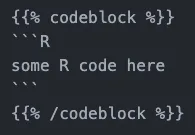
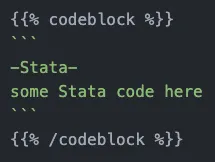
But what if you want to provide some code in a language that is not on that list? That's the case of Stata code, for instance.
In that case, you need to omit the language right after the three back ticks. This will disable syntax highlighting. Anyway, you can then specify the programming language to let the reader know which one it is, as shown here:
Use correctly language & structure of code blocks
- correct 👍 (NO space between apostrophes and the language sign):

- incorrect 👎 (space between apostrophes and the language sign):

- incorrect 👎 (language sign between stripes or brackets:):

LaTeX Integration & Math Formulas
Simply place your math formulas:
- within single dollar signs for inline math:
$f(x)=x^2$yields: $f(x)=x^2$ - within double dollar signs for display:
$$f(x)=x^2$$yields: $$f(x)=x^2$$
Our webiste currently does not support notation so please stick to using dollar signs.
-
correct 👍 (using dollar signs): $P(X_{i}) ≡ Pr(D_i = 1 | X_i)$
-
incorrect 👎 (using {{katex}} notation): {{}} P(X_{i}) ≡ Pr(D_i = 1 | X_i) {{}}
Highlighting Boxes
We support four kind of highlighting boxes.
 Tip
TipThis is a tip
WarningThis is a warning
 Summary
This is a summary
 Example
This is an example
How to handle wide tables
If you're using wide tables, they may appear broken on smaller screens like mobile phones. Therefore, you should always wrap your tables within the wide-table shortcode.
This will make sure that the right edge of the table fades out on small screens and they become scrollable on the horizontal axis. The following is an example of a wide table:
| ------------- | ------------- | ------------ | ------------ | --------------- | --------------- |
| $\alpha$ | \alpha | $\beta$ | \beta | $\gamma$ | \gamma |
| $\delta$ | \delta | $\epsilon$ | \epsilon | $\varepsilon$ | \varepsilon |
| $\zeta$ | \zeta | $\eta$ | \eta | $\theta$ | \theta |
| $\vartheta$ | \vartheta | $\iota$ | \iota | $\kappa$ | \kappa |
| $\lambda$ | \lambda | $\mu$ | \mu | $\nu$ | \nu |
| $\xi$ | \xi | $\pi$ | \pi | $\varpi$ | \varpi |
| $\rho$ | \rho | $\varrho$ | \varrho | $\sigma$ | \sigma |
| $\tau$ | \tau | $\upsilon$ | \upsilon | $\phi$ | \phi |
| $\varphi$ | \varphi | $\chi$ | \chi | $\psi$ | \psi |
| $\omega$ | \omega | ||||
TipClick here to check out the Markdown file of this page to learn how these shortcodes are used in the text.
Adding Footnotes
Footnotes [^1] let you reference relevant information without disrupting the flow of what you're trying to say. Need to make use of footnotes? Here is how to add them in Markdown:
Footnotes[^1] let you (...)
[^1]: My reference
[^1]: Footnotes in Markdown
Writing Instructions
- Use the second person ("you") when speaking to our or talking about our users
- Content creators may refer to themselves in the first person ("I" in single-author articles, or "we" in multiple-author articles). Do remember to keep the focus on our users.
- Avoid personal references: e.g., in my career, on a project I run.
- We encourage the use of contractions: e.g., it’s, you’ll, you’re, we’re, let’s.
- We prefer shorter words over longer alternatives.
- e.g., "helps" is better than "facilitates"
- e.g., "uses" is better than "utilizes"
- Use an active voice wherever possible.
- Write conversationally: prepositions are okay to end sentences with. And another thing. You can even start sentences with "And" or "But."
- Be informal, but being clear is more important than being entertaining!
- Get to the point fast.
- Frame sentences positively: use positive language (e.g., be more efficient, write better code...), rather than negative language (e.g., avoid mistakes...).
- Avoid slang.
- Avoid jargon. We know it's difficult for you academics out there.
- Capitalize Your Headings Like This. But don't do that for articles and prepositions.
- Avoid headings to start with articles and "How to...". Of course we're telling you how to do it.
- Use
##,###,####for headers, not a standard line on bold. Use**only for bolded words or short sentences when you want to stress a concept. Learn more about markdown syntax here. - Do NOT use
#for headers. Instead, use the appropriatetitleflag for your main header. - Suggest at least one short link for your article! Combine an action verb and a noun like this: /VERB/NOUN (/do/this, /learn/that, /get/me). Ex. https://tilburgsciencehub.com/get/python. You will find these instructions in the contribution template.
-
Be consistent and double-check your file before sending!
TipIf you want to be credited for your work, don't forget to fill in the
authorandauthorlinkfields at the top of our templates with your name and a link to your personal webpage, respectively. WarningThe naming of your file matters!
We use the filename, which is different from the actual article's title, to extract information and display the current path within the navigation menu and on the breadcrumb trails. Please, choose your filename carefully!
Generally speaking, it's a good idea to name your file exactly like your main title, but using all lowercase letters and separating words with a
-.Example:
  Title: Automation with GNU Make
  Filename: automation-with-gnu-make.md
Add the correct tags
Every page has at the top of the code tags which, among others, help index the page.
---
tutorialtitle: "Web Scraping and API Mining [a good title] "
type: "web-scraping [very short title ~2/3 words with no capitols nor spaces]"
title: "Web Scraping and API Mining [the same good title]"
description: "[a short, relevant summary of what a particular page is about]"
keywords: "scrape, webscraping, beautifulsoup .. [relevant keywords to the page]"
weight: 1 [to determine the position in the navigation 1 at the top 99 at the bottom]
draft: false [false when finished, true when it is still a draft]
aliases: [other urls which lead to this page]
  - /learn/web-scraping-and-api-mining [first alias is the short link]
  - /topics/more-tutorials/web-scraping/web-scraping-tutorial/
---
Develop content for our target audience
When contributing content to our platform, please address at least one of our target groups.
-
Students and novice researchers who look for material developed, curated, and rigorously tested by professors and experienced users, ensuring them about quality and usability. Users may not know yet what (and why) they should learn the Tilburg Science Hub way of working. These users need to be onboarded first and guided through our content.
-
(Advanced) researchers and professors who look for useful material developed by their peers. These users have identified a problem, but need code snippets to use in their projects. Researchers seek to avoid mistakes that others have made before them, and look to get inspired by their colleagues. They may also use our platform to share their solutions to problems (e.g., in the form of building blocks or tutorials).
-
Teams and small businesses who wish to get inspired by how scientists work on on data-intensive projects. Tilburg Science Hub offers tools and knowledge to help teams work together better, more efficiently. Our content can be adopted by individual team members (i.e., adoption doesn't disturb the way of working of other team members), or jointly by a team (i.e., the entire team commits to the Tilburg Science Hub way of working).
-
Data science enthusiasts who encounter our site when working on their projects. We strive to become a key learning resource in the data science community.
WarningKeep in mind our key goals
Our platform focuses on usability (i.e., ability to quickly copy-paste code or download templates), speed (i.e., loading time), and attractiveness (i.e., visual appeal, “state-of-the-art” look, good writing).
Our platform is a (classical) two-sided market.
-
We attract novice and expert users that use our content in their work, and
-
We build a community of content creators that have an outspoken vision on how to conduct science efficiently.
WarningLicense
Text and content are licensed under a Creative Commons Attribution-NonCommercial-ShareAlike 4.0 International License. In other words, our content can be reused by anybody for non-commercial purposes, but needs to be properly cited.

-